 Reviews

 Proudly American

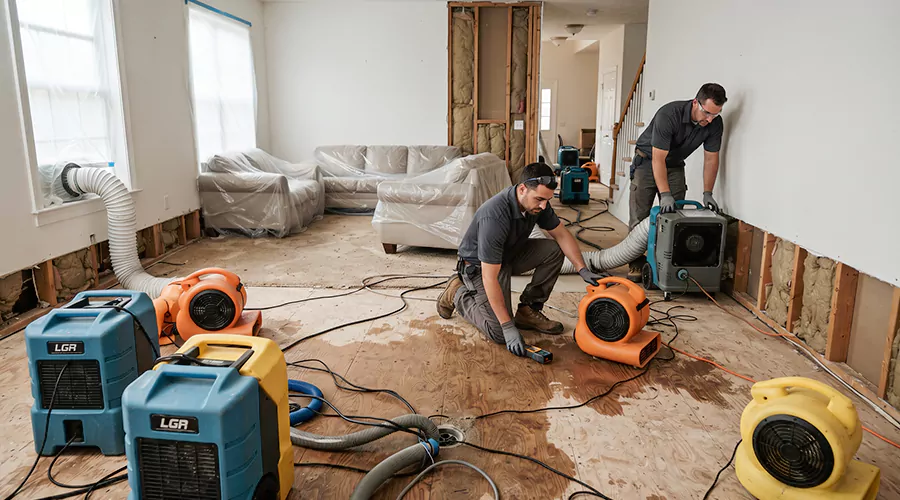
Structural drying is the controlled removal of moisture trapped inside building materials after water damage, and the extraction-and-drying phase commonly costs about $1,000 to $5,500 in 2026. It continues after standing water is gone because drywall or subfloors can remain wet even when the room looks dry.
The process uses measured airflow and dehumidification to move moisture out of materials. Moisture readings are then used to track drying progress instead of relying on touch or appearance alone.
Fast drying matters because the EPA recommends drying wet materials within 24 to 48 hours when possible to reduce the chance of mold growth.
What Does Structural Drying Mean?
Structural drying means removing excess moisture from the materials that make up a building rather than removing only visible water. These materials can hold water after puddles disappear. Drying continues until measurements show that affected materials have returned close to an appropriate dry condition.
Water can soak into areas such as:
- Drywall
- Wall framing
- Subflooring
- Hardwood flooring
- Concrete
- Baseboards
- Insulation
- Ceiling materials
- Wall cavities
This is why a room can look dry while moisture remains inside the structure.
Imagine a washing-machine supply line leaking across a bedroom floor. Water may be extracted from the carpet within an hour while the plywood beneath it stays wet for several days.
Water damage drying focuses on that remaining moisture rather than the puddle that was already removed.
How Is Structural Drying Different From Water Extraction?
Water extraction removes liquid water while drying removes moisture absorbed into building materials. Extraction normally happens first because pumps or wet extraction equipment can remove large amounts of water quickly. Drying then addresses what remains inside walls or flooring after the visible water is gone.
The difference can be seen here:
| Stage | Main Goal | Typical Method |
|---|---|---|
| Water removal | Remove standing water | Pumps or extraction equipment |
| Initial moisture check | Locate wet materials | Moisture meters |
| Drying | Release trapped moisture | Air movers |
| Dehumidification | Remove moisture from air | Dehumidifiers |
| Monitoring | Track progress | Repeat moisture readings |
| Completion | Confirm acceptable dryness | Final measurements |
Water extraction and remediation are therefore connected stages but they do different jobs.
A wet carpet provides a simple example. Extraction can remove water from the carpet surface while the subfloor underneath remains damp.
Wet carpet drying may require continued airflow after the carpet no longer feels wet.
Why Is Structural Drying Needed After Water Damage?
Drying is needed because moisture can remain inside porous materials long after exposed surfaces appear normal. That hidden moisture can support mold growth or cause swelling. It can also damage finishes if repairs begin before the structure has dried enough. The EPA recommends prompt drying after indoor water events.
Common consequences of incomplete drying include:
- Mold growth
- Musty odors
- Swollen drywall
- Cupped wood flooring
- Loose finishes
- Damaged insulation
- Soft subflooring
- Staining that returns after repair
The counterintuitive problem is that visible water isn't always the biggest concern.
Water can wick upward through drywall. It can also move beneath flooring through seams that are too small to notice from above.
A homeowner may remove every visible puddle and still have a wet wall cavity several hours later.
How Does the Structural Drying Process Work?
The drying process normally starts after the water source has been stopped and bulk water has been removed. Technicians then identify wet materials before creating airflow around them. Dehumidification removes moisture released into the air while repeated readings show whether the drying plan is working.
A typical process follows these steps:
- Stop the source of incoming water.
- Remove standing water.
- Inspect the affected rooms.
- Measure moisture in building materials.
- Remove materials that cannot remain.
- Position air-moving equipment.
- Set up dehumidification.
- Monitor moisture readings.
- Adjust equipment when needed.
- Confirm drying before repairs begin.
The IICRC S500 standard covers water-damage restoration procedures that include building science and drying technology. It also addresses psychrometry plus the equipment used during restoration.
The equipment isn't simply left running for a fixed number of days. Measurements are used to determine when drying has progressed enough.
What Equipment Is Used for Structural Drying?
Drying equipment is selected according to how much material became wet and where the water traveled. Air movers increase evaporation at wet surfaces while dehumidifiers remove water vapor from indoor air. Moisture instruments help determine whether the structure is actually becoming drier over time.
Common equipment includes:
- Air movers
- Commercial dehumidifiers
- Moisture meters
- Thermo-hygrometers
- Floor drying systems
- Extraction equipment
Air movers alone don't complete the job.
As water evaporates from drywall or wood it enters the surrounding air. If humidity stays high then evaporation slows.
Dehumidification removes that released moisture so additional water can continue leaving the building materials.
This relationship is why opening a window and placing a household fan in the room doesn't always produce the same result.
What Materials Take the Longest to Dry?
Dense materials usually take longer to dry because moisture can move deeper into them and leave more slowly. Hardwood or concrete can therefore remain wet after lightweight materials improve. Access also matters because trapped wall cavities receive less natural airflow than exposed surfaces.
Drying time often increases with:
- Hardwood flooring
- Thick wood framing
- Concrete
- Plaster
- Subflooring
- Enclosed wall cavities
- Wet insulation
Water damage carpet drying can also take longer when padding remains saturated beneath the carpet.
Flooring presents another challenge because moisture can become trapped between layers.
For example, hardwood may appear dry on top while the subfloor beneath still contains elevated moisture. Applying a new finish before both layers stabilize can create another problem later.
How Long Does Structural Drying Take?
Many ordinary residential drying projects run for about three to five days once extraction is complete. Heavily saturated materials can take longer. Dense assemblies may need extended drying because moisture moves out of them more slowly than it leaves exposed drywall or carpet.
A general timeline looks like this:
| Condition | Typical Drying Time |
|---|---|
| Small clean-water loss | About 2 to 3 days |
| Moderate room damage | About 3 to 5 days |
| Multiple wet rooms | About 3 to 7 days |
| Hardwood or dense materials | Often 5 to 7 days or longer |
| Severe saturation | Can extend beyond one week |
These timeframes are planning guides rather than automatic stopping points.
Flood damage drying can require more time when large areas have remained wet before extraction starts.
The drying equipment should not be removed just because a scheduled number of days has passed. Moisture readings provide a better completion point.
How Do You Know When the Structure Is Dry?
A structure is considered ready for the next stage when moisture readings show that affected materials have returned to an appropriate dry condition compared with similar unaffected materials. Surface appearance isn't enough because wood or drywall can feel dry before internal moisture has fallen sufficiently.
Common checks include:
- Moisture readings in drywall
- Measurements in wood framing
- Subfloor readings
- Indoor relative humidity
- Comparison with dry reference areas
- Changes recorded during monitoring visits
A moisture meter provides far more useful information than touching the wall with your hand.
The EPA recommends keeping indoor relative humidity below 60 percent when possible. A range between 30 and 50 percent is preferred for normal moisture control.
The important point is that no single moisture number works for every material. The dry target depends on what the material normally measures in that building.
What Happens if a Building Is Not Dried Properly?
Incomplete drying can allow moisture to remain behind finished materials where it is difficult to see. Mold can then develop when conditions remain damp. Wood flooring can also change shape while drywall can lose its physical condition. Repairs applied over wet material may fail later.
Problems can progress in stages:
| Stage | What May Happen | Possible Cost Effect |
|---|---|---|
| First hours | Water spreads into nearby materials | Limited mitigation may still be possible |
| First 24 hours | Drywall or flooring remains saturated | More drying equipment may be needed |
| 24 to 48 hours | Mold risk increases if materials stay wet | Cleanup scope can grow |
| Several days | Swelling or odor may develop | Material removal becomes more likely |
| Extended exposure | Deeper building damage can occur | Reconstruction costs can increase |
The EPA advises drying water-damaged areas within 24 to 48 hours when possible because mold often develops when wet materials remain damp longer.
The drying clock effectively starts when the water event begins rather than when cleanup equipment arrives.
That is one reason rapid extraction can reduce the amount of later demolition.
How Much Does Structural Drying Cost in 2026?
Water extraction with structural drying commonly costs about $1,000 to $5,500 in 2026 for residential projects. One-room drying can fall around $1,000 to $2,500 while multi-room projects can reach $2,500 to $5,500. Specialty hardwood drying can cost more.
A current planning breakdown looks like this:
| Drying Scope | Typical 2026 Cost |
|---|---|
| Standing-water extraction | $500 to $2,500 |
| Small one-room drying | $1,000 to $2,500 |
| Multi-room drying | $2,500 to $5,500 |
| Hardwood specialty drying | $2,000 to $7,000 |
| Monitoring visit | $75 to $200 |
Air movers may cost roughly $50 to $110 per unit each day in current 2026 pricing. Commercial dehumidifiers commonly add about $100 to $170 per unit each day.
More equipment doesn't automatically mean wasteful spending. Larger wet areas release more moisture and may require greater drying capacity.
The number of drying days also changes the total quickly because equipment typically runs continuously.
What Warning Signs Suggest Hidden Moisture Remains?
Hidden moisture should be suspected when building materials continue changing after visible water has been removed. Recurring stains or swelling often indicate that an area wasn't completely dried. A musty odor can also develop when concealed materials stay damp even though exposed flooring looks normal.
Check for these warning signs:
- Drywall remains cool or damp.
- Baseboards begin swelling.
- Hardwood starts cupping.
- Flooring edges lift.
- Paint develops bubbles.
- Water stains return.
- A musty smell develops.
- Carpet padding stays damp.
- Cabinets swell near the floor.
- Indoor humidity stays unusually high.
- A ceiling stain continues expanding.
- Moisture appears in an adjoining room.
Water damage drying company assistance may become appropriate when several of these conditions remain after household drying attempts.
A returning stain is particularly useful information. It can indicate either continuing leakage or moisture still moving through the material.
What Can You Check Yourself Before Repairs Begin?
A safe home check is to compare the affected area with a similar dry area before installing new finishes. Use an inexpensive moisture meter if the device is designed for the material you are checking. A hygrometer can also show whether indoor humidity remains unusually high.
Follow this simple process:
- Identify an unaffected reference area.
- Measure that dry material first.
- Measure the affected material.
- Record both readings.
- Repeat the check the next day.
- Watch whether the wet reading moves toward the dry reference.
Do not cut into walls simply to find hidden moisture.
Also avoid treating one reading as proof that the entire room is dry. Water rarely spreads in a perfectly even pattern.
Several readings across the affected area provide a more useful picture.
When Should You Call a Professional?
Professional help is appropriate when water has entered several building layers or remains hidden inside walls. Large losses also require more drying capacity than household fans can provide. Contaminated water is another reason to avoid normal DIY methods because material removal and cleaning requirements change.
Consider structural drying services when:
- Several rooms are affected.
- Water entered wall cavities.
- Hardwood flooring is saturated.
- Insulation became wet.
- The subfloor remains damp.
- Moisture reached the ceiling below.
- Sewage caused the water damage.
- Outdoor floodwater entered the property.
- Drying has stalled.
- Mold is already visible.
- Moisture readings remain elevated.
- You cannot identify how far the water traveled.
Professional drying adds measurement to the process. That is useful because the goal isn't to run equipment for a certain number of hours.
The goal is to document drying progress until the remaining materials reach an acceptable condition.
How Can You Reduce the Need for Extensive Drying?
The best way to reduce drying work is to stop water quickly before it moves into additional building materials. Regular inspection of plumbing connections can catch small leaks early. Leak alarms can also provide warning before water spreads under flooring or reaches a wall cavity.
Use these preventive steps:
- Know where the main water shutoff is.
- Check supply hoses several times each year.
- Inspect beneath sinks every month.
- Watch the water heater for leakage.
- Test sump pumps before heavy rain.
- Use leak alarms near appliances.
- Check ceilings after major storms.
- Repair plumbing leaks promptly.
- Keep indoor humidity below 60 percent.
- Investigate musty odors early.
The EPA recommends drying wet materials within 24 to 48 hours when possible. Fast source control gives you a better chance of meeting that window.
A small leak caught in minutes may need little more than local extraction. The same leak left running for hours can require several days of drying.
Conclusion
Structural drying removes moisture that remains inside walls or flooring after visible water is gone. Extraction starts the recovery process while controlled airflow and dehumidification complete the drying stage. Moisture readings show when materials are ready for repair. If water has entered several building layers, professional measurement can prevent wet materials from being covered too early. This week, locate your main shutoff and check leak-prone areas for moisture.
Frequently Asked Questions
Is structural drying the same as using fans?
No. Fans create airflow but proper drying also controls humidity and tracks moisture inside the affected materials.
Does drywall always need to be removed after water damage?
No. Some drywall can dry in place when the water is clean and the board remains physically sound. Saturated or contaminated drywall may need removal.
Can hardwood floors be dried instead of replaced?
Sometimes. Specialty floor drying systems can remove moisture when boards haven't suffered permanent damage.
Can structural drying prevent mold?
Prompt drying reduces the conditions mold needs for growth. The EPA recommends drying wet materials within 24 to 48 hours when possible.
Should drying equipment run overnight?
Commercial drying equipment commonly operates continuously during the drying period. Equipment is normally adjusted or removed based on moisture readings.
Can a wall feel dry while still containing moisture?
Yes. The exposed surface can dry before the center or backside of the material. Moisture measurement is more reliable than touch alone.